
English





Date 2026.10.27
Early-stage mineral exploration often begins with a practical challenge: prospective geology lies beneath cover, targets extend across a large area, and drilling budgets are limited. Exploration teams need subsurface information to decide where further investment is justified.
Air core drilling—commonly written as aircore and abbreviated as AC—helps address this challenge. It uses a rotating blade bit to cut through suitable formations and compressed air to carry the resulting sample to the surface through an inner tube.
Its effectiveness depends on more than drilling speed. To understand where aircore adds value, it is essential to examine how samples are recovered, what geological questions they can answer, and when another drilling method becomes necessary.
Aircore is a rotary drilling method that uses dual-wall drill rods and compressed air to recover subsurface material. A typical system includes a blade bit, inner and outer drill tubes, an air supply, and surface sample collection equipment.
During drilling, the bit cuts material at the bottom of the hole. Compressed air travels down the annular space between the inner and outer tubes, passes through ports near the bit, and carries the drilled material back to the surface through the central return passage. This arrangement reduces the sample’s exposure to material along the borehole wall during its return journey. Technical reference: Alcoa Technical Report Summary
Despite its name, aircore should not be assumed to produce continuous, intact core. In typical mineral exploration applications, the recovered sample consists of chips, particles, and fines rather than the cylindrical rock core obtained through diamond drilling.
This distinction defines the information it can provide. Aircore samples can help identify lithology, weathering, alteration, and geochemical anomalies, but offer limited evidence of original rock fabric, fracture orientation, and vein geometry.
Understanding aircore requires separating two functions: cutting the formation and transporting the sample.
In conventional blade aircore drilling, rotational torque and axial load drive the cutting action. The blades shear and scrape material from the bottom of the hole. Compressed air primarily clears the bit face and transports the cuttings.
The process follows a continuous sequence:
This explains why aircore performs well in suitable weathered and relatively soft formations. Where the blades can cut effectively, drilling and sample removal can proceed efficiently. When the bit encounters hard, competent rock, penetration may slow, wear may increase, and continued drilling may become uneconomic.
Performance depends on the complete system. Bit geometry, inner-tube diameter, connection seals, airflow, pressure, and surface collection equipment all influence drilling efficiency and sample recovery. Compressor pressure or bit hardness alone cannot determine whether a system is suitable for a project.
In areas with limited outcrop, surface observations and soil sampling may not establish whether a geochemical anomaly originates from underlying bedrock or transported material.
Aircore drilling provides vertical samples through cover and weathered profiles, helping geologists investigate questions such as:
Its value often emerges from the combined pattern across multiple holes. Together, these holes can help build a subsurface geological framework and narrow the search area.
Interpretation must account for weathering and landscape processes. Elements may be leached, transported, or concentrated during weathering, while overlying sediments may have moved from their original source. A shallow anomaly therefore does not, by itself, establish the location or extent of a deeper mineralised body.
The anomaly’s position within the profile, host material, weathering intensity, and relationship to adjacent holes should all inform follow-up decisions.
Aircore is generally suited to unconsolidated or weathered materials that a blade bit can cut effectively. These may include certain sandy sediments, residual soils, and weathered rock.
However, unconsolidated ground is not always straightforward to drill. Coarse gravel, boulders, unstable hole walls, and air loss can disrupt progress and sample recovery.
| Ground condition | Potential effect |
|---|---|
| Relatively uniform, readily cut weathered material | Supports steady penetration and consistent sample return |
| Sticky clay-rich material | May adhere to inner tubes and collection equipment, causing blockages and carryover |
| Gravel, boulders, or hard bands | May reduce penetration, increase wear, or cause early termination |
| Formations with substantial air loss | May reduce the airflow available to lift samples |
| Water-bearing intervals | May produce wet samples, adhesion, and splitting difficulties |
| Fresh, competent hard rock | Limits the effectiveness of conventional blade aircore drilling |
Aircore holes are often drilled to blade refusal. However, refusal may result from a quartz vein or a local hard layer rather than the fresh bedrock boundary. The reason for termination must therefore be considered alongside the recovered geology. Field example: St Barbara Exploration Report
There is also no universal maximum drilling depth. Achievable depth depends on ground conditions, groundwater, hole diameter, air supply, losses, and the ability to maintain effective sample return. A rig’s nominal capability must be assessed against actual site conditions.
Returning samples through an inner tube reduces some contamination risks, but it does not automatically guarantee representative samples.
Material can still be lost, mixed, or segregated between the cutting face and the laboratory.
If only part of a drilled interval reaches the surface, the recovered material may not represent the entire interval. Bias becomes particularly important when fine and coarse particles are lost at different rates.
Sample assessment should therefore consider unusual changes in recovered quantity, particle size, and whether these changes coincide with assay variation.
Groundwater can cause cuttings to stick, agglomerate, or obstruct the return system. Even when material reaches the surface, producing a representative subsample may become more difficult.
Published exploration reports document groundwater-related variability in aircore recovery and the recording of dry, moist, and wet sample conditions. These observations provide context for evaluating assay reliability. Project reference: Catalyst Metals ASX Announcement
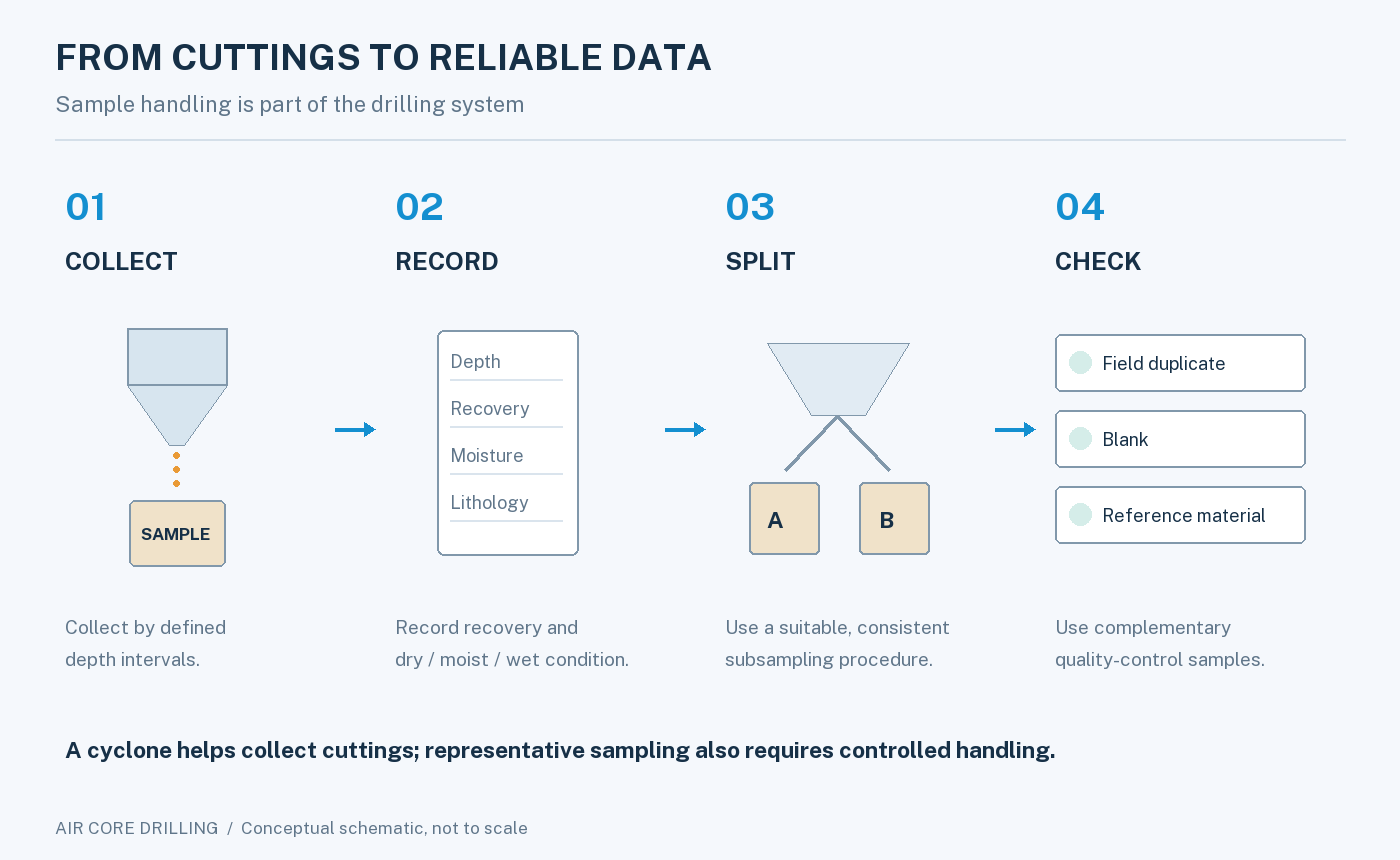
Material retained in inner tubes, return hoses, cyclones, and collection containers can enter later samples. Sticky clay and wet ground can make this more difficult to manage.
Cleaning procedures, checks on abnormal sample return, and operational records help identify and reduce carryover.
The laboratory usually receives only a fraction of the total material collected at the rig. Taking a grab sample from one part of a sample pile can introduce bias where particles have segregated or mineral distribution is uneven.
Subsampling procedures should suit the material and its moisture condition. Field duplicates, blanks, and certified reference materials provide complementary checks on sampling and analytical performance; each addresses different potential sources of error.
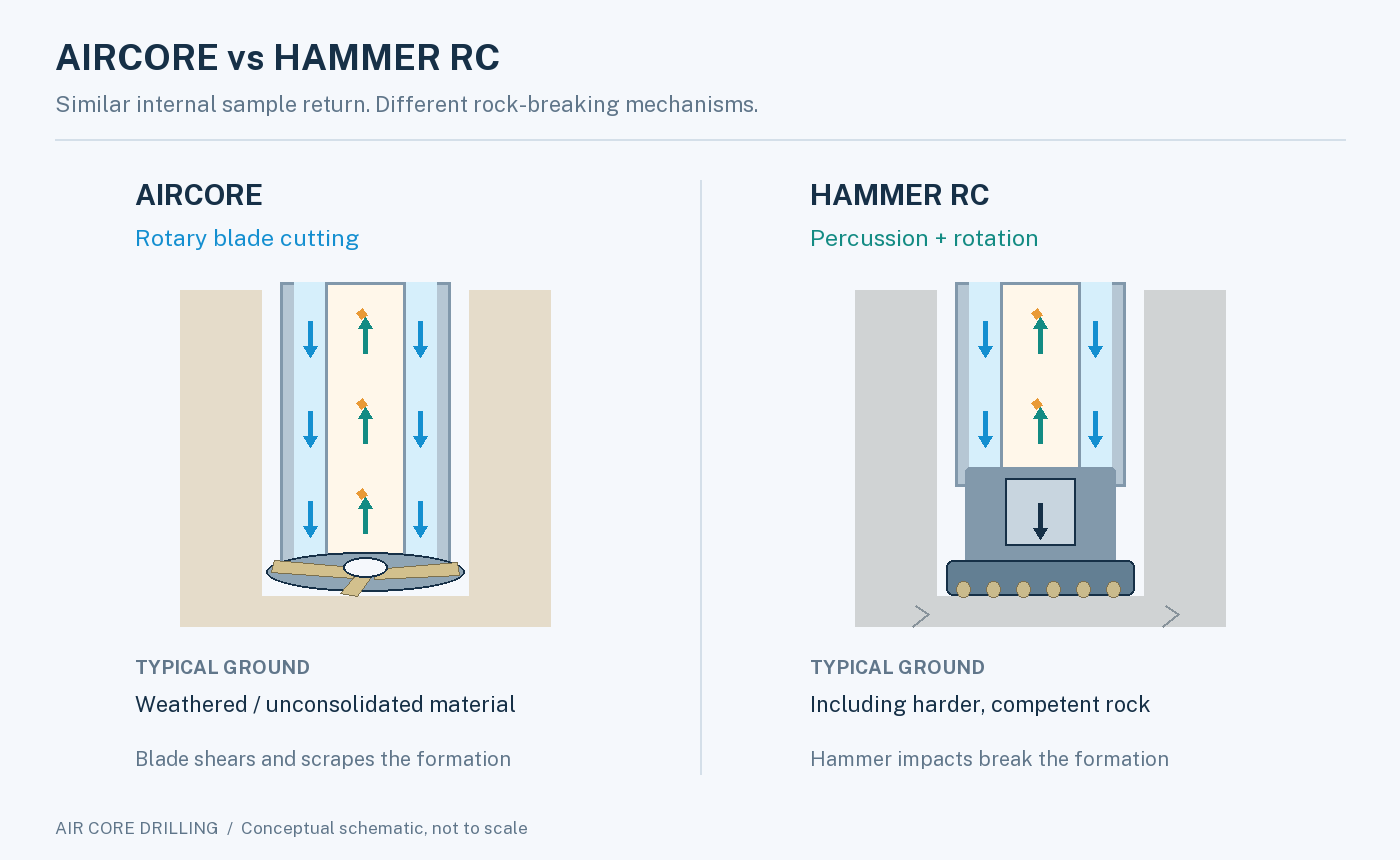
These methods often serve different purposes within the same exploration programme.
| Feature | Aircore | Common single-wall RAB | Common downhole-hammer RC | Diamond drilling |
|---|---|---|---|---|
| Main drilling action | Rotary blade cutting | Rotary cutting or percussion, depending on configuration | Percussion combined with rotation | Annular cutting to recover core |
| Typical sample return | Through an inner tube | Between the drill rods and borehole wall | Through an inner tube | Core retained within a core barrel |
| Typical ground suitability | Unconsolidated and weathered materials | Depends on bit and equipment configuration | Includes harder rock formations | Formations requiring core recovery |
| Main sample form | Chips, particles, and fines | Cuttings | Rock chips | Cylindrical core |
| Common exploration role | Cover investigation and initial anomaly delineation | Preliminary investigation | Mineralisation testing and deeper drilling | Detailed geological interpretation and structural information |
One terminology issue deserves attention: aircore itself uses a reverse-circulation sample return path. In mineral exploration, however, “RC drilling” commonly refers to dual-wall reverse-circulation drilling using a downhole hammer.
The distinction therefore involves the cutting or rock-breaking mechanism and ground suitability, as well as the sample return arrangement. Method definitions: Novo Resources
Selection should begin with the geological question. Aircore may be economical for investigating weathered profiles and screening anomalies. RC may be more suitable for testing mineralisation in hard rock, while diamond drilling provides core for examining geological relationships and rock structure in greater detail.
Aircore is often considered an economical exploration method, but the quoted drilling rate per metre does not capture the full project cost.
Mobilisation, access preparation, consumables, standby time, sample handling, laboratory analysis, and any repeat drilling required because of poor sample quality all affect the final expenditure.
A more useful question is:
What does it cost to obtain a reliable sampling interval that supports the next exploration decision?
A programme may complete substantial metres yet leave its main geological question unresolved if recovery is poor in the target horizon. Conversely, adjusting hole locations, sampling intervals, or termination criteria can improve the value of the investigation without maximising total metres drilled.
Aircore’s economic advantage depends on matching the method to the ground, designing an effective programme, and maintaining sample quality.
An effective programme should establish three things before drilling begins.
The objective may be to determine cover thickness, trace an anomaly through the weathered profile, or obtain geochemical samples near the bedrock interface.
That objective should guide hole placement, sampling horizons, and termination criteria.
Sampling intervals, splitting methods, wet-sample procedures, recovery records, and quality control should reflect the commodity, mineral grain size, and intended use of the data.
A procedure suitable for broad reconnaissance may require refinement before the results can support more detailed interpretation.
The team should establish how it will respond to anomalies, poor recovery, unexpected hard ground, and incomplete penetration of the target horizon.
Multi-metre composite samples, for example, can reduce early analytical costs but may dilute a narrow anomalous interval. Retaining the original interval samples allows more detailed analysis when a composite result warrants investigation.
Clear follow-up criteria help convert drilling results into practical decisions.
Aircore can generate valuable exploration evidence, but an isolated high-grade result does not establish the size of a mineralised body.
Likewise, the length of an anomalous downhole interval is not automatically its true thickness. Interpretation requires an understanding of hole orientation, mineralisation geometry, and constraints from other drilling.
A hole with no significant anomaly also requires context. Did it reach the intended horizon? Was recovery adequate? Did a hard layer cause early termination?
Whether aircore data can support resource evaluation depends on the deposit, sampling validation, quality control, and the adequacy of the overall dataset. The drilling method’s name alone cannot determine fitness for that purpose.
Air core drilling offers an efficient way to investigate cover sequences and weathered ground, helping exploration teams identify and prioritise targets.
Its value depends on combining drilling productivity with representative sampling. Appropriate equipment, suitable ground conditions, recovery records, moisture observations, effective cleaning and splitting procedures, and sound geological interpretation all contribute to useful results.
When these elements are in place, aircore provides a stronger basis for deciding where to drill next and where further exploration investment is justified.
None
 Previous
Review Checklist for Underground Core Rig Mobility and Safety
In today’s fast-paced drilling industry, ensuring the mobility and safety of underground core rigs is paramount. Mining companies often face challenges such as terrain variability and safety compliance, impacting overall productivity. The solution lies in utilizing state-of-the-art underground core drilling rigs like those from jcdrillingrig. These rigs not only enhance operational efficiency
Next
Explore Drilling Solutions
Review Checklist for Underground Core Rig Mobility and Safety
In today’s fast-paced drilling industry, ensuring the mobility and safety of underground core rigs is paramount. Mining companies often face challenges such as terrain variability and safety compliance, impacting overall productivity. The solution lies in utilizing state-of-the-art underground core drilling rigs like those from jcdrillingrig. These rigs not only enhance operational efficiency
Date 2026.10.15
In the realm of mineral exploration, effective and efficient drilling is crucial. The need for reliable and precise methods in confined mine areas has driven many mining professionals to consider underground core drilling. This technique allows for detailed geological assessments, helping companies identify valuable resources while minimizing disruption to the surrounding environment. However,
Date 2026.10.15
The drilling industry is experiencing a notable evolution as companies seek more efficient methods to conduct mineral exploration and geological studies. Understanding the top differences between surface and underground core drilling setups is essential for stakeholders in this field. With specific challenges such as material extraction costs increasing by 25% over the past five years, and
Date 2026.10.12
Surface core rigs are designed for drilling operations that occur on the surface of the ground. They are typically used in mineral exploration and geological studies.
Date 2026.10.09
Fractured ground poses significant challenges for construction and drilling operations, particularly for those utilizing Surface Core Drilling Rig systems. The complexities of recovery can lead to increased project timelines and costs, frustrating contractors and engineers alike. Fortunately, implementing effective recovery techniques can accelerate progress and enhance overall productivity. By
Date 2026.10.08

Please leave your information.
